👁️ Valet Visual
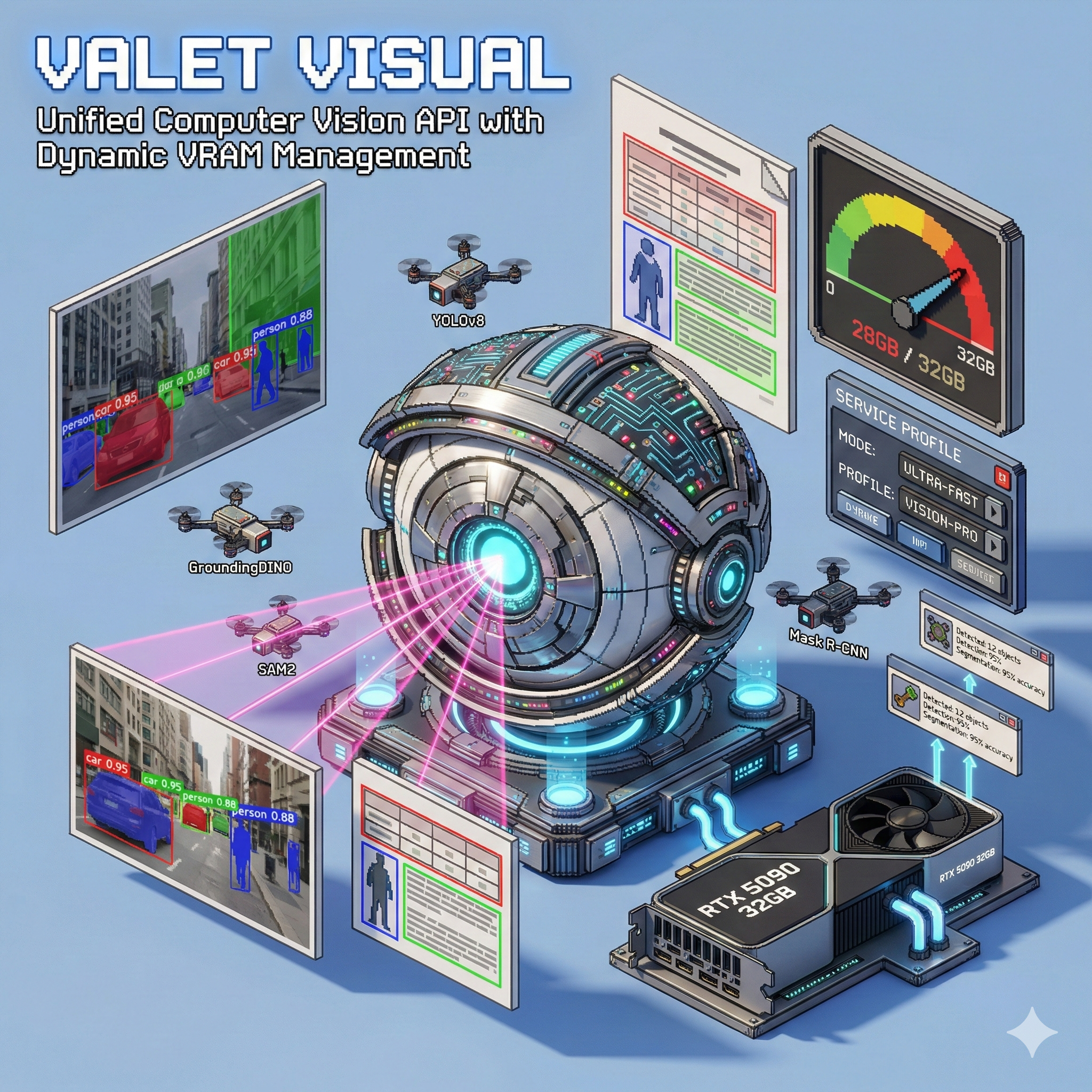
One API for object detection, document layout, and segmentation
Home Lab Project · 10 Models · Dynamic VRAM Management · Service Profiles
> The Problem
Computer vision has many specialized models, each with its own API:
- YOLO for fast object detection
- SAM2 for segmentation
- GroundingDINO for open-vocabulary detection
- DocLayout-YOLO for document analysis
Running them all simultaneously would exhaust GPU memory. Loading them on-demand adds latency. Each has a different API format.
I needed a unified service that could intelligently manage models and present a single, consistent API.
> The Solution
Valet Visual provides a unified REST API for all computer vision tasks:
# Detect objects in an image
curl -X POST http://localhost:9400/v1/detect \
  -H "Content-Type: application/json" \
  -d '{"image_url": "https://example.com/image.jpg", "detector": "yolo11"}'

# Open-vocabulary detection
curl -X POST http://localhost:9400/v1/detect \
  -d '{"image_url": "...", "detector": "grounding-dino", "prompt": "person.car.dog"}'

# Segment detected objects
curl -X POST http://localhost:9400/v1/detect \
  -d '{"image_url": "...", "detector": "yolo11", "segment": true, "segmenter": "sam2"}'
The service dynamically loads/unloads models based on requests and available VRAM.
> Key Features
- 🎯 Unified API - One endpoint for all detection and segmentation tasks
- 🔄 Dynamic Loading - Models load on-demand, unload when not needed
- 📊 VRAM Tracking - Real-time GPU memory monitoring
- 📦 Service Profiles - Pre-configured model combinations for common tasks
- 🔥 Warm Models - Keep frequently-used models loaded
- 📄 Document Analysis - Specialized layout detection for PDFs
- 🖼️ Batch Processing - Process multiple images in one request
- 📈 Prometheus Metrics - Full observability at
/metrics
> Architecture
flowchart LR
    subgraph Clients
        A[Content Processor]
        B[ComfyUI Agent]
        C[Other Services]
    end

    subgraph Valet Visual
        D[FastAPI Server]
        E[Model Manager]
        F[VRAM Tracker]
    end

    subgraph Models
        G[YOLO11]
        H[DocLayout-YOLO]
        I[GroundingDINO]
        J[SAM2]
    end

    subgraph GPU
        K[RTX 5090 32GB]
    end

    A & B & C --> D
    D --> E
    E --> F
    E <--> G & H & I & J
    G & H & I & J --> K
The Model Manager handles loading/unloading based on requests and available VRAM, while tracking GPU memory in real-time.
> Available Models
Detectors
| Model | VRAM | Speed | Description |
|---|---|---|---|
| yolo11 | 500MB | Fast | 80 COCO classes |
| yolo11-seg | 600MB | Fast | YOLO11 + instance segmentation |
| doclayout | 800MB | Fast | Document layout (11 classes: Table, Figure, Text...) |
| yolo-world | 1.5GB | Medium | Open vocabulary via text prompts |
| grounding-dino | 1.5GB | Medium | Open vocabulary, high accuracy |
Segmenters
| Model | VRAM | Speed | Description |
|---|---|---|---|
| sam2 | 2.5GB | Fast | SAM2.1-hiera-large, video support |
| sam2-base | 1.5GB | Fast | SAM2.1-hiera-base-plus |
| sam-base | 1.5GB | Fast | Original SAM base |
| sam-large | 2.5GB | Medium | Original SAM large |
| sam3 | 2GB | Fast | Segment Anything 3 (requires approval) |
> Service Profiles
Pre-configured model combinations for common use cases:
| Profile | Models | VRAM | Use Case |
|---|---|---|---|
none |
- | 0 | Standby mode |
minimal |
yolo11 | 500MB | Basic detection |
document |
doclayout | 800MB | PDF layout analysis |
document-segment |
doclayout + sam-base | 2.3GB | Document element extraction |
open-vocab-fast |
yolo-world | 1.5GB | Custom class detection |
open-vocab-precise |
grounding-dino | 2GB | High accuracy detection |
grounded-sam2 |
grounding-dino + sam2 | 4GB | Detection + segmentation |
Apply a profile with:
curl -X POST http://localhost:9400/v1/profiles/document-segment/apply
> API Endpoints
| Endpoint | Method | Description |
|---|---|---|
/v1/detect |
POST | Universal detection (JSON body) |
/v1/detect/upload |
POST | Detection with file upload |
/v1/detect/batch |
POST | Batch image detection |
/v1/segment |
POST | Standalone segmentation |
/v1/segment/upload |
POST | Segmentation with file upload |
/v1/document/analyze |
POST | Document layout analysis |
/v1/models |
GET | List all models and status |
/v1/models/{id}/load |
POST | Load a specific model |
/v1/models/{id}/unload |
POST | Unload a specific model |
/v1/profiles |
GET | List available profiles |
/v1/profiles/{name}/apply |
POST | Apply a service profile |
/v1/gpu |
GET | GPU status and VRAM |
/metrics |
GET | Prometheus metrics |
> Detection Request
{
  "image_url": "https://example.com/image.jpg",
  "detector": "yolo11",
  "confidence": 0.25,
  "segment": true,
  "segmenter": "sam2",
  "output_format": "masks",
  "return_visualization": true,
  "return_cropped": false
}
Response
{
  "success": true,
  "detector": "yolo11",
  "segmenter": "sam2",
  "processing_time_ms": 127.5,
  "image_size": [1920, 1080],
  "detection_count": 5,
  "detections": [
    {
      "label": "person",
      "confidence": 0.92,
      "bbox": [100, 200, 300, 500],
      "class_id": 0,
      "mask": "base64...",
      "area": 45000
    }
  ],
  "visualization": "base64..."
}
> Document Layout Classes
The doclayout detector identifies 11 document elements:
| Class | Description |
|---|---|
Text |
Body text paragraphs |
Title |
Document/section titles |
Figure |
Images, charts, diagrams |
Figure_Caption |
Figure captions |
Table |
Tables |
Table_Caption |
Table captions |
Header |
Page headers |
Footer |
Page footers |
Page_Number |
Page numbers |
Formula |
Mathematical formulas |
List |
Bulleted/numbered lists |
> VRAM Management
The service tracks GPU memory in real-time:
curl http://localhost:9400/v1/gpu
{
  "gpu_available": true,
  "gpu_name": "NVIDIA GeForce RTX 5090",
  "vram_total_mb": 32111,
  "vram_allocated_mb": 2500,
  "vram_free_mb": 29611,
  "models_loaded": {
    "grounding-dino": {"vram_mb": 1500, "loaded_at": "..."},
    "sam2": {"vram_mb": 2500, "loaded_at": "..."}
  },
  "can_load": ["yolo11", "doclayout", "yolo-world", "sam2-base"]
}
Models are automatically unloaded when VRAM is needed for higher-priority requests.
> Integration Example
Used by Content Processor for document analysis:
import httpx

async def analyze_document_page(image_bytes: bytes) -> dict:
    """Extract layout elements from a document page."""
    async with httpx.AsyncClient() as client:
        response = await client.post(
            "http://valet-visual:9400/v1/document/analyze",
            files={"file": ("page.png", image_bytes, "image/png")},
            data={"segment": "true"}
        )
        return response.json()

# Returns detected tables, figures, text regions with masks
> Tech Stack
| Component | Technology | Why |
|---|---|---|
| API | FastAPI | Async, automatic OpenAPI docs |
| Object Detection | Ultralytics YOLO11 | Fast, accurate, well-maintained |
| Document Layout | DocLayout-YOLO | Specialized for documents |
| Open Vocabulary | GroundingDINO | Text-guided detection |
| Segmentation | SAM2 (HuggingFace) | State-of-the-art masks |
| GPU | CUDA + PyTorch | GPU acceleration |
| Metrics | Prometheus | Observability |
| Container | Docker + NVIDIA runtime | GPU passthrough |
> Current Status
| Metric | Value |
|---|---|
| GPU | RTX 5090 (32GB VRAM) |
| Available Models | 10 |
| Service Profiles | 7 |
| Port | 9400 |
| Container | valet-visual:latest |
Running stable on my seed server.
> What I Learned
- Dynamic loading saves VRAM - Only load what you need, when you need it
- Profiles simplify operations - Pre-configured combinations reduce API complexity
- HuggingFace transformers just work - SAM2 via transformers avoided CUDA compatibility issues
- Unified APIs reduce friction - One format for all models makes integration easier
- VRAM tracking is essential - Without it, OOM errors are inevitable
> What's Next
- Video segmentation with SAM2
- Model caching to disk for faster reload
- Priority-based model eviction
- WebSocket streaming for large batches
- SAM3 integration (pending HF approval)