
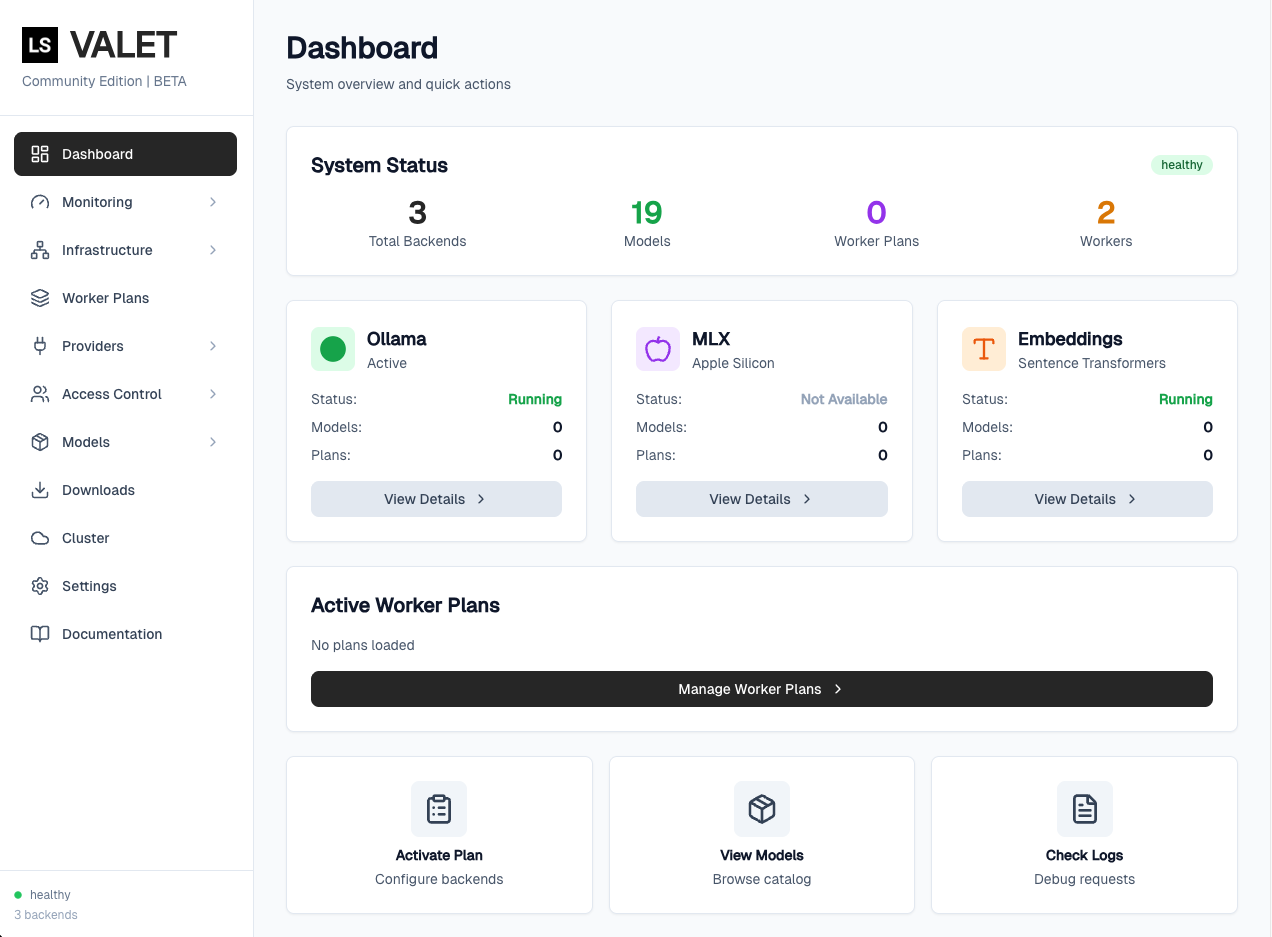
🚀 Valet Model Runtime
A drop-in OpenAI replacement that routes between local GPUs and cloud APIs
Home Lab Setup · GPUs: 2× RTX 5090 · Throughput: 1,320 req/s
The Problem
Running local LLMs sounds great until you try to do it at scale:
- VRAM conflicts - Multiple services fighting over GPU memory
- No visibility - Which service used how many tokens?
- No fallback - Local GPU busy = requests fail
- API fragmentation - Different APIs for Ollama, OpenAI, Anthropic
I was running multiple AI services that all needed LLM access. Each had its own connection to Ollama, leading to constant VRAM conflicts and no way to track usage.
The Solution
Valet Model Runtime is a unified gateway that presents an OpenAI-compatible API while handling all the complexity behind the scenes.
Point your apps at Valet instead of OpenAI. Same SDK, same API, but now you control the infrastructure.
# Before: Direct to OpenAI
client = OpenAI(api_key="sk-...")

# After: Through Valet (same code!)
client = OpenAI(
    base_url="http://valet:9300/v1",
    api_key="not-needed"
)
Key Features
- 🔌 OpenAI Compatible - Use existing code unchanged, just change the base URL
- ⚡ Multi-GPU Load Balancing - Distribute requests across multiple GPUs with round-robin or capacity-based routing
- ☁️ Cloud Overflow - Automatic failover to Mistral AI, OpenRouter when local capacity is exhausted
- 👁️ Vision Support - OpenAI vision format with automatic image handling
- 📊 PostgreSQL Analytics - Request logging, token tracking, full-text search
- 🔄 Rate Limiting - Per-client, per-queue with RPM and concurrent limits
- 📈 Prometheus Metrics - Full observability at
/metrics
Architecture
flowchart LR
    subgraph Clients
        A[Your Apps]
        B[OpenAI SDK]
    end

    subgraph Valet["Valet Model Runtime"]
        C[API Gateway<br/>OpenAI Compatible]
        D{Routing<br/>Policy}
        E[Queue System]
        F[Analytics]
    end

    subgraph Local["Local GPUs"]
        G[GPU 1<br/>RTX 5090]
        H[GPU 2<br/>RTX 5090]
    end

    subgraph Cloud["Cloud Fallback"]
        I[Mistral AI]
        J[OpenRouter]
    end

    A --> B
    B -->|/v1/chat/completions| C
    C --> D
    D -->|Capacity Available| E
    D -->|Overflow| I & J
    E --> G & H
    C --> F
The gateway receives OpenAI-formatted requests, decides whether to route locally or to cloud based on current GPU capacity, and returns responses in OpenAI format. Your code never knows the difference.
Performance
Measured on NVIDIA RTX 5090 (32GB VRAM):
| Metric | Performance |
|---|---|
| API Throughput | 1,320 req/s |
| LLM Inference | 11.2 req/s @ 525 tok/s |
| Embeddings | 2,974 emb/s (batch 64) |
| Time to First Token | 70ms |
| Success Rate | 100% |
The gateway itself adds minimal overhead. Most latency is in the LLM inference itself.
Tech Stack
| Component | Technology | Why |
|---|---|---|
| API | FastAPI + Gunicorn | Async, multi-worker, OpenAPI docs |
| High-Perf Routes | Go | Streaming, token counting at speed |
| LLM Runtime | Ollama | Simple, GPU-optimized |
| State/Cache | Redis | Request queuing, rate limits |
| Analytics | PostgreSQL | Durable logging, FTS |
| Admin UI | SvelteKit | Modern, fast dashboard |
| Container | Docker | Single-container deployment |
My Home Lab Setup
Currently running on a two-node cluster in my home dev environment:
| Node | Role | Hardware | VRAM |
|---|---|---|---|
| seed | Gateway + Worker | RTX 5090 | 32GB |
| sapling | Worker | RTX 5090 | 32GB |
Cloud overflow routes to Mistral AI and OpenRouter in round-robin when local capacity is full. This gives me 128k context windows when needed without keeping large models loaded locally.
What I Learned
Building this taught me a lot about LLM infrastructure:
- The LLM is the easy part - Request routing, failure handling, and observability are where the complexity lives
- VRAM management is tricky - Models don't unload cleanly; nvidia-smi verification is essential
- Streaming needs special handling - Can't use standard HTTP middleware for SSE
- Rate limiting is subtle - Per-client, per-model, RPM vs TPM vs concurrent
What's Next
- Open-source release (cleaning credentials)
- Kubernetes Helm chart
- More cloud provider integrations
- Cost tracking and budgets