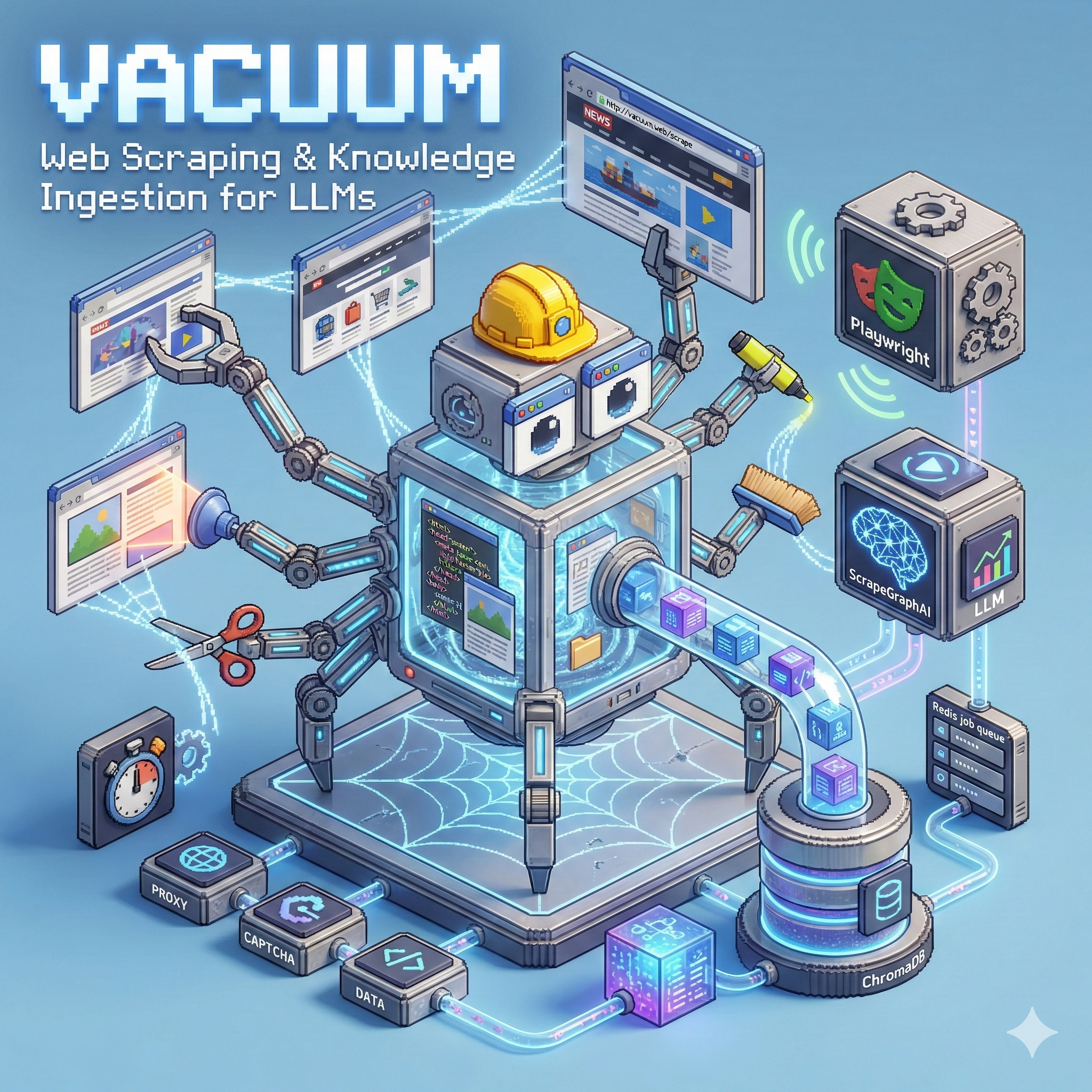
🌀 Vacuum
LLM-powered web content extraction and knowledge ingestion
Home Lab Project · 4 Search Engines · Plugin Architecture
The Problem
I needed to feed my AI agents with fresh, structured knowledge from the web:
- Raw HTML is useless - LLMs need clean, extracted content
- Web scraping is brittle - Selectors break when sites change
- Search is fragmented - Different APIs, different formats
- No memory - Every scrape starts from scratch
Traditional scrapers return HTML soup. I wanted a system that could understand pages, extract the relevant parts, and store them for retrieval.
The Solution
Vacuum uses LLMs to intelligently extract content from web pages. Instead of CSS selectors, you describe what you want in natural language, and the LLM figures out how to get it.
# Traditional scraping (fragile)
title = soup.select_one("h1.article-title").text
content = soup.select_one("div.content-body").text

# Vacuum (intelligent)
result = await vacuum.browse(
    url="https://example.com/article",
    prompt="Extract the article title, author, date, and main content"
)
# Returns structured JSON with exactly what you asked for
Key Features
- 🧠 LLM-Powered Extraction - Uses ScrapeGraphAI with Valet Runtime
- 🔍 Multi-Engine Search - Tavily, Serper, Brave, DuckDuckGo in one API
- 📦 Smart Caching - TTL strategies by content type (news vs docs)
- 🎯 Reranking - Reorder results by relevance using mxbai-rerank
- 🖼️ Visual Analysis - Extract content from images via Valet Visual
- 🔌 Plugin System - Add custom content sources
- 💾 Vector Storage - ChromaDB for semantic search
Architecture
flowchart TB
    subgraph Input["Input Sources"]
        U[URLs]
        Q[Search Query]
        D[Documents]
    end

    subgraph Vacuum["Vacuum Service"]
        direction TB
        API[FastAPI Gateway]

        subgraph Core["Core Operations"]
            B[Browse<br/>Single URL]
            S[Scrape<br/>Depth Crawl]
            F[Fetch<br/>Multi-source]
        end

        subgraph Services["Services"]
            WS[Web Search<br/>4 engines]
            RR[Reranker<br/>mxbai-rerank]
            EM[Embeddings<br/>mxbai-embed]
        end
    end

    subgraph Backend["Backend"]
        VR[Valet Runtime<br/>LLM]
        VV[Valet Visual<br/>Vision]
        CH[ChromaDB<br/>Vectors]
        RD[Redis<br/>Cache]
    end

    U & Q & D --> API
    API --> B & S & F
    API --> WS
    B & S & F --> VR
    B & S & F --> RD
    WS --> RR
    RR --> EM --> CH
Core Operations
Browse - Single URL Extraction
Extract structured content from a single page:
curl -X POST http://localhost:8500/browse \
  -H "Content-Type: application/json" \
  -d '{
    "url": "https://docs.python.org/3/library/asyncio.html",
    "prompt": "Extract the main concepts and code examples"
  }'
Scrape - Depth Crawling
Crawl a site to a specified depth:
curl -X POST http://localhost:8500/scrape \
  -H "Content-Type: application/json" \
  -d '{
    "url": "https://fastapi.tiangolo.com/",
    "prompt": "Extract all tutorial content",
    "depth": 2
  }'
Fetch - Multi-Source Retrieval
Gather content from multiple URLs in parallel:
curl -X POST http://localhost:8500/fetch \
  -H "Content-Type: application/json" \
  -d '{
    "urls": ["https://a.com", "https://b.com", "https://c.com"],
    "prompt": "Summarize the main points"
  }'
Web Search Integration
Vacuum provides a unified search API across multiple engines:
flowchart LR
    subgraph Query["Search Query"]
        Q[Query Text]
    end

    subgraph Engines["Search Engines"]
        T[Tavily<br/>AI-optimized]
        S[Serper<br/>Google results]
        B[Brave<br/>Privacy-focused]
        D[DuckDuckGo<br/>Free fallback]
    end

    subgraph Output["Unified Response"]
        R[Standardized Results]
        A[Direct Answer]
        F[Follow-up Questions]
    end

    Q --> T & S & B & D
    T & S & B & D --> R
    T --> A & F
| Engine | Best For | API Key Required |
|---|---|---|
| Tavily | AI applications, returns clean content | Yes |
| Serper | Google search results | Yes |
| Brave | Privacy, no tracking | Yes |
| DuckDuckGo | Free fallback, no key needed | No |
The system uses auto mode by default, selecting the best available engine based on your API keys.
Caching Strategy
Different content types have different freshness requirements:
| Content Type | TTL | Rationale |
|---|---|---|
| Documentation | 24 hours | Changes infrequently |
| News | 30 minutes | Stale quickly |
| Social | 5 minutes | Real-time content |
| Default | 1 hour | Balance freshness/performance |
Cache is stored in Redis with automatic expiration:
flowchart LR
    R[Request] --> C{Cache Hit?}
    C -->|Yes| CR[Return Cached]
    C -->|No| F[Fetch + Extract]
    F --> S[Store with TTL]
    S --> CR2[Return Fresh]
Plugin System
Extend Vacuum with custom content sources:
Creating a Plugin
from vacuum.plugins.base import BasePlugin, PluginMetadata

class MyPlugin(BasePlugin):
    @classmethod
    def metadata(cls) -> PluginMetadata:
        return PluginMetadata(
            name="my-plugin",
            version="1.0.0",
            description="Custom content source"
        )

    async def process(self, request):
        # Your extraction logic here
        return {"content": "..."}
Plugins are auto-discovered from the plugins directory and registered at startup.
Tech Stack
| Component | Technology | Why |
|---|---|---|
| API | FastAPI | Async, fast, OpenAPI docs |
| Extraction | ScrapeGraphAI | LLM-powered scraping |
| LLM | Valet Runtime | Unified model access |
| Vision | Valet Visual | Image extraction |
| Cache | Redis | Fast, TTL support |
| Vectors | ChromaDB | Semantic search |
| Reranking | mxbai-rerank | Result relevance |
What I Learned
- LLMs beat selectors - Natural language extraction is more resilient than CSS selectors
- Caching is essential - Web scraping without caching wastes compute and hits rate limits
- Multi-engine search - No single search API is perfect; having fallbacks is crucial
- Plugin architecture - Adding new sources should be easy, not a code change
What's Next
- YouTube transcript extraction
- PDF ingestion pipeline
- Scheduled refresh for important sources
- Better deduplication in ChromaDB